
The right tummy tuck is decided by your anatomy, not by which scar is shortest. What matters most is how much loose skin you have, where it sits, whether the abdominal muscles have separated, and what you want the finished result to look like.
Austin Plastic Surgeon performs all five abdominoplasty techniques, and the right one differs from patient to patient. Every procedure below is illustrated to show the same three things: where the incision sits, which skin comes out, and what happens to the belly button.
To find out which tummy tuck fits your anatomy, contact us online or call one of our three locations directly:
- Austin: (512) 334-9917
- San Antonio: (210) 750-1851
- West Lake Hills: (512) 334-9917
Contents
- 1 Where the Excess Skin Sits
- 2 Find Your Starting Point
- 3 Four Territories, Four Answers
- 4 Comparing the Five Techniques
- 5 The High-Definition Tummy Tuck
- 6 The Mini Tummy Tuck With Liposculpting
- 7 The Reverse Tummy Tuck With Liposculpting
- 8 Circumferential Abdominoplasty (the Lower Body Lift)
- 9 The Fleur-de-Lis Tummy Tuck
- 10 We Can Remove Skin. We Cannot Change Skin.
- 11 What if the Problem Is the Muscle, Not the Skin?
- 12 How to Figure Out Which Abdominoplasty Is Right for You
- 13 Personal Consultation
- 14 Cost of a Tummy Tuck in Austin, San Antonio, and West Lake Hills
- 15 FAQ
- 15.1 Which tummy tuck has the smallest scar?
- 15.2 Do you tighten the muscles during a mini tummy tuck?
- 15.3 Can a mini tummy tuck fix loose skin above my belly button?
- 15.4 I lost over 100 pounds. Which tummy tuck do I need?
- 15.5 Can I combine a tummy tuck with breast surgery?
- 15.6 Will a tummy tuck tighten loose, crepey skin?
Where the Excess Skin Sits
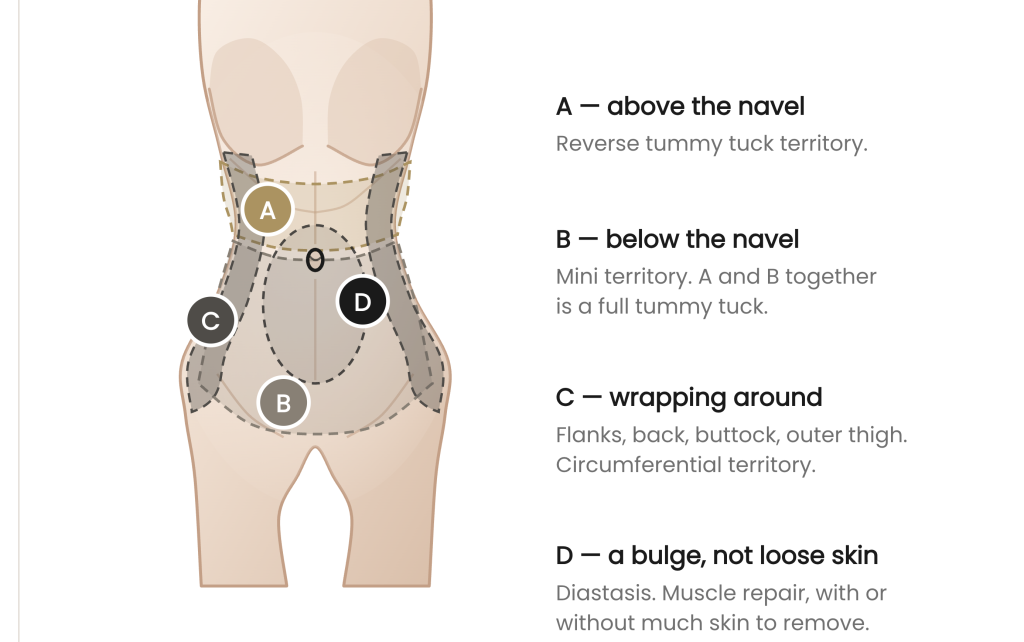
Before anything else, pinch the skin and notice where it gathers. That single observation points to the operation more reliably than anything else:
- Below the belly button only → mini tummy tuck
- Above and below the belly button → full, high-definition tummy tuck
- Above the belly button only → reverse tummy tuck
- Wrapping around to the buttocks and outer thighs → circumferential abdominoplasty
- Vertical and horizontal, after very large weight loss → fleur-de-lis tummy tuck
- No loose skin, but a diastasis → mini tummy tuck
Incision length, recovery, and what you pair it with all matter, but they come after that first question. Below is how Dr. Franco walks patients through it in consultation.
Find Your Starting Point
Five questions. Answer at least the first three and you will get the procedure your anatomy most likely points to, along with what else is worth raising in consultation. Nothing is stored or sent anywhere.
Four Territories, Four Answers
Comparing the Five Techniques
| Procedure | Where the loose skin is | Typical incision | Belly button moved? | Ideal candidate |
|---|---|---|---|---|
| High-definition (full) tummy tuck | Above and below the belly button | Hip to hip, low | Yes | Post-pregnancy or post-weight-loss with diastasis and moderate to significant laxity |
| Mini tummy tuck | Below the belly button only | Shorter, low, near the C-section line | No | High belly button, isolated lower laxity, or diastasis with minimal excess skin |
| Reverse tummy tuck | Above the belly button only | Under the breast crease | No | Upper abdominal laxity, often paired with breast surgery |
| Circumferential abdominoplasty | All the way around, including buttocks and outer thighs | Around the waist | Yes | Major weight loss with circumferential laxity and buttock descent |
| Fleur-de-lis tummy tuck | Vertical and horizontal | Hip to hip plus a vertical midline | Yes | Extreme weight loss, often 100 lb or more |
The High-Definition Tummy Tuck
The high-definition tummy tuck is what we used to call a “traditional” tummy tuck, but it evolved. This is still the most common abdominal procedure we do, and it looks almost nothing like the tummy tuck of fifteen years ago. The old version was mostly about removing skin, redoing the belly button, and maybe tightening the muscle. That was it.
Now, practically every full tummy tuck in our practice includes liposculpting. We remove a lot of the deep fat, define the waist, and bring out the anatomy you have worked hard for. Shape is the goal now, and flat is just the starting point. Modern tummy tucks are about shaping and sculpting the entire torso, which is why we call it a total torso transformation.
Technically, the incision runs low, usually about hip to hip. This allows us to remove the excess skin between the belly button and the incision, tighten the muscle with a plication that closes the separation and flattens the abdominal wall, and reposition the belly button. Liposuction of the flanks and back is almost always part of it, because sculpting only the front and leaving the sides untouched gives you a flat stomach on a body that does not match.
In the past, we either did not liposuction the abdomen or were very conservative to protect the abdominal skin and minimize complications. That has been one of the biggest evolutions of modern tummy tucks. At Austin Plastic Surgeon, we aggressively but strategically liposuction the anterior abdomen, which has become possible because of modern technology such as the AYON, ultrasound assistance, and an improved understanding of the anatomy of the abdominal wall.
Good candidate: You have loose skin above and below the belly button, muscle separation from pregnancy or weight change, and stubborn deep fat that has not moved with diet or training. This is the version that handles the most territory, and it combines well with almost everything: lipo 360, breast surgery, and fat transfer to the buttocks or hips.
The trade-off is the incision. It is longer and lower than a mini, and there is an incision around the belly button. We are always straightforward with patients about that. However, it is important to keep the focus on your dream outcome and what is ultimately going to accomplish that goal.
The Mini Tummy Tuck With Liposculpting
Mini tummy tucks are popular for obvious reasons. Smaller incision, more discreet, and because we do not touch the belly button, the result often reads as more natural. Nobody is looking for a scar around the navel.
There is a myth worth clearing up. Some surgeons do not tighten the muscle during a mini abdominoplasty. At Austin Plastic Surgeon, we typically do. You can absolutely plicate the muscle through a mini incision, and for a lot of patients that muscle repair is the whole reason they came in.
The other honest limitation is incision length. Patients hear “mini” and picture something two inches long. There is a floor on how short it can be, because we still need to remove real skin from the lower abdominal wall and leave you with a clean contour. The incision usually sits below or right at a C-section scar and runs a little longer.
Good candidate: You have a high belly button and loose skin isolated below it, or a significant diastasis with very little excess skin at all. Those are the two profiles that do best.
Probably not a candidate: You have loose skin above the belly button. A mini can make upper laxity look worse, because tightening below pulls attention to whatever is still loose above. We have seen many more mini candidates since GLP-1 medications became common, and it is one of the more important conversations we have in consultation.
The Reverse Tummy Tuck With Liposculpting
Reverse tummy tucks used to be a rarity in our practice. Now we do them regularly, and the shift has been driven by the weight loss revolution. We have many patients in that 10 to 30 pound weight loss range who feel absolutely incredible but want to look as good as they feel. They most commonly come in with a little loose skin above the belly button while the rest of the abdomen looks great.
Think of it as a mini tummy tuck turned upside down. Instead of removing skin from below the belly button, we undermine the skin down to the navel, lift, and remove the excess above it. The incision is hidden in the breast crease, which is why this so often gets done alongside a breast augmentation or lift — when the procedures are done simultaneously, the same incision can serve both.
Good candidate: You have isolated excess skin above your belly button. These patients often do well combining the procedure with liposculpting and skin tightening devices such as Renuvion or Quantum RF.
Probably not a candidate: You have excess skin below the belly button, a large diastasis, or a significant amount of excess skin overall. Because the belly button stays in place, there is only so much skin that can come out and still keep the incision hidden under the breast.
We are careful about who we offer a reverse tummy tuck to, as only a select group of patients do well with it. However, when it fits, it fits well. We are seeing more of these because of Ozempic, Zepbound, and Mounjaro.
Circumferential Abdominoplasty (the Lower Body Lift)
A few years ago we did these a handful of times a year. Now it is a regular part of our practice and we often do several a week. So many patients have lost a significant amount of weight that has resulted in more than just loose skin of the abdomen — it also involves the legs, thighs, and buttock.
A circumferential abdominoplasty takes the incision all the way around. The front is done much like our high-definition tummy tuck, with liposculpting, muscle plication, and contouring. It then continues around to address loose skin at the buttock and hips, which allows us to tighten the entire waist, lift the outer thighs, and lift the buttocks in the same operation. For patients who have lost a large amount of weight, a procedure that only addresses the front leaves most of the problem behind.
There are also several options to enhance the shape of the buttock. Most patients simply want to lift and tighten it, but for those who want to restore volume lost on their weight loss journey, we can combine the procedure with an auto-augmentation — using your own tissue, which would otherwise be discarded, to restore volume rather than removing it entirely.
Good candidate: Significant weight loss has affected not only your abdomen but your buttock and thighs. If you can pinch loose skin at your flanks, your back, and your outer thighs, a front-only procedure is typically not going to get you where you want to be.
The Fleur-de-Lis Tummy Tuck
This one is built for extreme weight loss, typically well over 100 pounds and sometimes 150 to 200. That said, it varies significantly from person to person and depends far more on skin laxity than on the number on the scale.
The difference is direction. Most tummy tucks remove skin vertically, pulling top to bottom. A fleur-de-lis adds a midline vertical incision so we can remove skin horizontally as well, tightening the waist from side to side. Patients who have both vertical and horizontal laxity will still have loose skin after a standard abdominoplasty, because that operation only pulls in one direction.
Yes, it is more of an incision, and we do not soften that. But it is not about the scar. It is about the treatment that completes your journey and gives you the outcome you pictured when you started. No other procedure removes this much skin, and for the right patient the change in shape is dramatic. It can also be combined with a circumferential abdominoplasty when the goal is a true full torso reshape.
Good candidate: You have a significant amount of loose skin on your abdomen running in both directions, generally after very large weight loss.
We Can Remove Skin. We Cannot Change Skin.
Skin turgor, or elasticity, changes when skin has been stretched. It is similar to a rubber band that has been overstretched and no longer recoils. Some rubber bands snap back; others have been stretched too many times and never do. The more weight we lose and the older we are, the less likely skin is to bounce back.
Surgery removes skin, but it does not change the quality of the skin you keep. That is where energy devices earn their place. Renuvion, which uses helium plasma, and Quantum RF have become mainstays in our practice for exactly this reason, because they address the character of the skin rather than just the amount of it. They are often what takes a good result and makes it look tight rather than simply smaller.
None of these procedures happen in isolation anyway. Tummy tucks get combined with liposculpting, breast augmentation, breast lifts, fat transfer, auto-augmentation, and energy devices, because most patients have more than one issue to solve.
What if the Problem Is the Muscle, Not the Skin?
There is a small group of patients who do not have loose skin after pregnancy or weight loss but still have a prominent abdomen. They often feel as if they are still pregnant. It is not a skin problem — it is diastasis recti, a separation of the abdominal muscles that shows up as a bulge no amount of core work will flatten. Sit-ups can actually make it look worse.
For those patients, muscle plication is the treatment of choice. Depending on whether there is any excess skin, that might mean a mini tummy tuck or a full one. Plication is also part of most of the other procedures above, so it is rarely an either-or decision. We will often place patients with this concern on a GLP medication first, to decrease as much visceral fat as possible before the muscle repair.
How to Figure Out Which Abdominoplasty Is Right for You
Ask yourself five questions before your consultation. Honest answers here get you most of the way to the answer:
- How much loose skin do I actually have? Not how much I feel like I have. Pinch it in the mirror.
- Where is it? Above the belly button, below it, or both?
- Does it wrap around? Outer thighs, buttocks, back.
- Is skin the only issue, or is there a muscle bulge too?
- Does my skin still work like a rubber band?
A lot of patients come in asking for the shortest scar. We understand the instinct, and mini abdominoplasty is a great operation when the anatomy fits. But choosing an operation based on scar length instead of anatomy is how people end up disappointed with a technically perfect result. A shorter scar that leaves your loose skin behind is not a win. It cuts the other way too — nobody needs a fleur-de-lis for a small amount of lower laxity.
Personal Consultation
Your personal consultation is where anatomy, goals, and technique get matched to each other. Dr. Franco will review your medical history, examine where your skin actually gathers, assess whether the abdominal muscles have separated, and talk through what each option would and would not accomplish for you.
We wrote this guide so you can walk in already knowing what your actual issue is, so the conversation can be about matching the operation to your anatomy instead of starting from scratch. Most patients end up combining more than one procedure, and the plan we build will reflect that.
If you are on a weight loss plan, post-pregnancy, or somewhere in between and you are not sure which category you fall into, contact us online or call one of our offices to schedule your personal consultation:
- Austin: (512) 334-9917
- San Antonio: (210) 750-1851
- West Lake Hills: (512) 334-9917
Cost of a Tummy Tuck in Austin, San Antonio, and West Lake Hills
The cost of your tummy tuck will vary based on which technique your anatomy calls for, whether you combine it with liposculpting, breast surgery, or energy devices, and a handful of other factors. Once we establish your treatment plan, we will provide you with a detailed cost outline. We also offer financing options to help make treatment more accessible. We encourage you to explore Austin Plastic Surgeon’s perks memberships and pricing page before your appointment to see a rough pre-consultation estimate.
FAQ
Which tummy tuck has the smallest scar?
The mini tummy tuck. The incision sits low, usually at or just below a C-section scar, and runs slightly longer than that scar, with no incision around the belly button. The reverse tummy tuck also has a well-hidden scar, tucked into the breast crease.
Do you tighten the muscles during a mini tummy tuck?
At Austin Plastic Surgeon, we typically do. Some surgeons do not, which is where the myth comes from, but muscle plication through a mini incision is very doable and is often the main reason a patient is having surgery.
No, and it can make it look worse. Upper abdominal laxity needs either a full tummy tuck or a reverse tummy tuck, depending on how much skin is involved and where it sits.
I lost over 100 pounds. Which tummy tuck do I need?
Most likely a circumferential abdominoplasty, a fleur-de-lis, or both. The deciding factors are whether your laxity wraps around to the buttocks and outer thighs, and whether you have horizontal laxity in addition to vertical.
Can I combine a tummy tuck with breast surgery?
Yes. Reverse tummy tucks in particular are often done at the same time as a breast augmentation or lift, since the incision is shared. Full tummy tucks are also commonly combined with breast procedures, lipo 360, and fat transfer.
Will a tummy tuck tighten loose, crepey skin?
It removes skin, but it does not improve the quality of the skin that remains. That is what Renuvion and Quantum RF are for, and we frequently use them in the same operation.