Sculpted. Not stuffed.
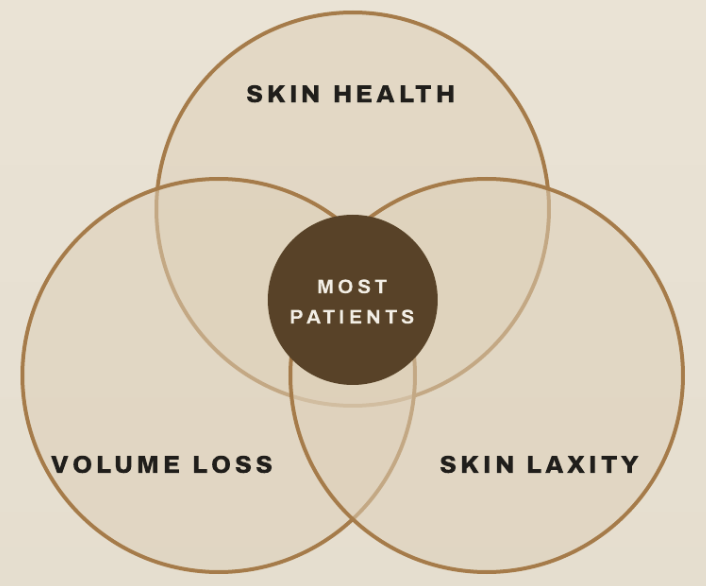
Ozempic face is the hollow, tired or loose look the face can get during fast weight loss on a GLP-1 like Ozempic, Wegovy, Mounjaro or Zepbound. It is three problems at once: volume loss, skin health and skin laxity. It is very treatable, and the best results come from starting early, ideally by month three.
Losing the weight was the hard part, and you did it. What surprises people is the face. It loses weight with the rest of you, and it usually shows the change first, because it has the least room to hide it.
I see this every week in Austin. Patients come in thirty, sixty, ninety pounds down, feeling better than they have in years, and then they say some version of the same thing: “I love my body. I don’t love my face.” This guide is what I walk them through. Why it happens, what is actually changing under the skin, the four phases of treatment, and every option from your skincare shelf to surgery.
You do not need to know which treatment you want. You need to know the options exist, and that the best time to start is earlier than most people think.
Contents
- 1 What is Ozempic face?
- 2 Does Ozempic actually cause Ozempic face?
- 3 Why does my face look older after weight loss?
- 4 Where does Ozempic face show up first?
- 5 When should I start treating Ozempic face?
- 6 The four phases of treating Ozempic face
- 7 Should I just put the volume back?
- 8 What is skin stacking?
- 9 What are dermaClae, Lipoderma and Renuva?
- 10 Do I need a facelift for Ozempic face?
- 11 How much downtime does each treatment have?
- 12 The whole plan on one page
- 13 How do I prepare for an Ozempic face consultation?
- 14 Frequently asked questions about Ozempic face
- 14.1 Will I get Ozempic face?
- 14.2 Should I wait until I finish losing weight?
- 14.3 Will Ozempic face go away on its own?
- 14.4 Won’t filler just make me look puffy?
- 14.5 What is the best treatment for Ozempic face?
- 14.6 Can I get treatments while I am still on a GLP-1?
- 14.7 How long do results last?
- 14.8 Can my face be treated alongside my body?
- 14.9 Where can I get Ozempic face treatment in Austin?
- 15 You did the hard part. Let your face catch up.
- 16 About the author
- 17 References
What is Ozempic face?
Ozempic face is a nickname for the facial changes that come with rapid weight loss: hollow temples, flat cheeks, darker under-eyes, crepey skin, jowls and a looser neck. The medication made it common enough to need a name, but any fast weight loss can do it.
Almost every patient I see for Ozempic face has some mix of three things happening at the same time:
- Volume loss. The fat pads that support the face deflate. The face looks hollow rather than smaller.
- Skin health. The skin gets thinner, drier and less resilient. Texture and lines show more.
- Skin laxity. Collagen did not have time to contract as fast as the weight came off, so the envelope loosens and sags.
Three different problems, three different fixes. Treat one and you still see the other two in the mirror.
| If this is what you see | What is driving it | And this is the territory |
|---|---|---|
| Hollow temples | Volume | Precision volume, placed to support, not puff |
| Sunken or flat cheeks | Volume · Laxity | Structure first, then support the skin over it |
| Dark, hollow under-eyes | Volume · Skin health | Skin quality plus careful, fine-grade volume |
| Dull, crepey, more lines | Skin health | Skin health and collagen stimulation |
| Jowls and a softer jawline | Laxity | Tighten and define the envelope |
| Loose skin at the neck | Skin health · Laxity | Tighten from underneath, or lift |
| Two or three of the above | Volume · Skin health · Laxity | A stacked plan across the phases |
Does Ozempic actually cause Ozempic face?
No. Ozempic face is not a direct side effect of semaglutide or tirzepatide. It is what rapid weight loss of any kind does to the face. Speed is why the medication gets the blame. The faster you lose, the further your collagen falls behind.
GLP-1 medications have been life changing for our patients. I am a believer. But the medication does not pick where the fat comes off. It leaves the belly, the waist and the double chin, which is what you wanted. It also leaves the temples, the cheeks and the under-eyes, which you did not.
Here is the part I want every patient to hear. Ozempic face is not inevitable. It is unmanaged. Your face is going to lose weight with the rest of you, and I can’t stop that. What it looks like afterward is a different story, and that part depends on whether anyone planned for it.
Why do some faces show it more than others?
- Age. Skin bounces back a little less every year.
- Genetics. Some faces hold volume. Some let it go.
- Speed. Fast loss outruns your collagen.
- Amount. The more you lose, the more it reads.
- Structure. Your face shape and bones decide what shows.
Why does my face look older after weight loss?
Because the face is built in layers, and weight loss changes each one differently. Fat pads shrink, the skin thins and the retaining ligaments that anchor skin to bone suddenly have less to hold up. The skin sags between those anchors, and that is where jowls and folds form.
Think of the face from the outside in:

- Skin. Quality, texture and collagen live here.
- Superficial fat pads. These give the face its fullness and are often the first to deflate.
- SMAS and muscle. The supportive fibrous layer. This is what a deep plane facelift repositions.
- Deep fat pads. These sit on bone and hold up the midface. Lose them and the cheek flattens.
- Bone. The frame. Structural filler is placed here to lift and define.
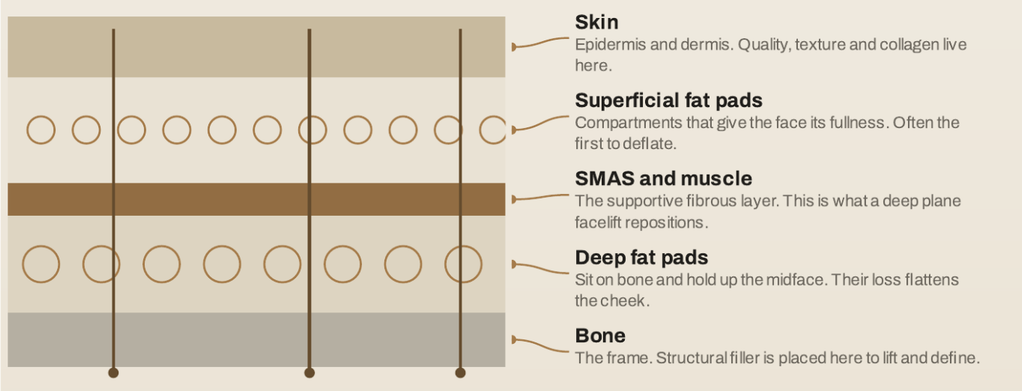
Patients usually come in asking about a device or a filler they saw online. The better question is which layer needs the work. A treatment aimed at the skin will not fix a problem in the deep fat pads, no matter how good it is. And volume placed in the wrong layer is exactly how a face ends up looking stuffed instead of sculpted.
Where does Ozempic face show up first?
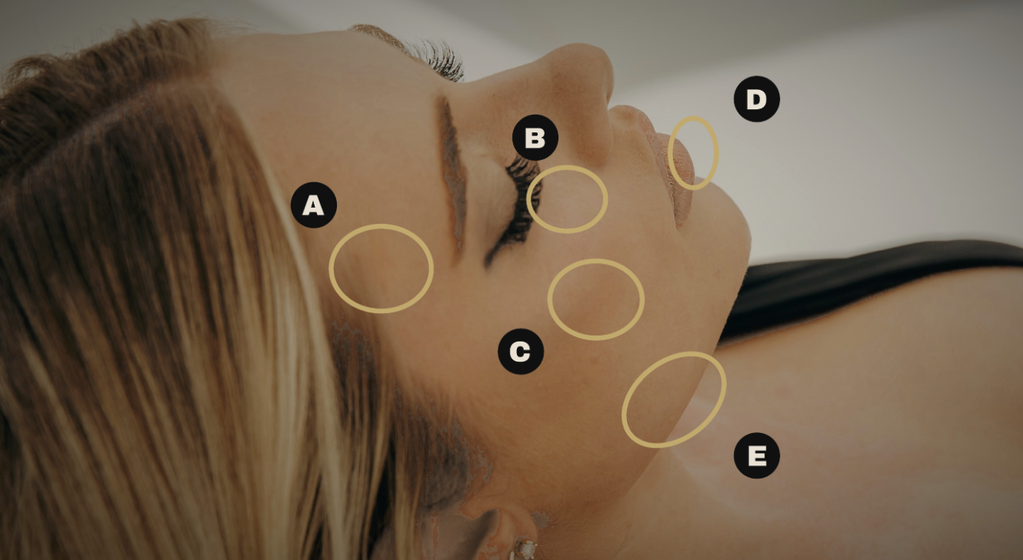
| Area | What you notice | What usually helps |
|---|---|---|
| Temples | Hollowing that makes the face look narrow and tired | Precision volume, placed to support, not puff |
| Under-eyes | Darker and sunken; the skin is thin | Skin quality plus careful, fine-grade volume |
| Cheeks and midface | Flattened support; the cheek drops and the skin follows | Structure first, then support the skin over it |
| Lips | Thinner and longer as the lip loses volume | Fine volume or a lip lift |
| Jawline and neck | Jowls and a softer edge | Tighten from underneath, or lift |
| Skin everywhere | Texture, lines and dullness | Skin health and collagen stimulation |
TWO CHECKS YOU CAN DO TODAY
Side light. Stand next to a window and look at your temples and cheeks in profile. Shadows that were not there before are volume.
The lift. Gently lift the skin at your jawline toward your ear. If the jowl disappears, laxity is leading. If it lifts but still looks hollow, you have both.
When should I start treating Ozempic face?
Start with your weight loss, not after it. At the very least, start some form of skin health treatment by month three. Waiting until goal weight usually means more treatment later, not less.

I can tell you this from personal experience. I started treatments in month three of my own weight loss. I wish I had started in month one.
Like a lot of our patients, I was skeptical that I would really lose the weight and keep it off, so my skin was not the focus. Now that we know these medications work, we build the entire plan from day one. You are making changes to your overall health. That has to include your skin.
Treat it while you lose it. Not after.
The four phases of treating Ozempic face
There are four phases of skin health during a weight loss journey. Most people only think about the third one. How early you start and how much you do depends on how much weight you plan to lose, the current health of your skin and your goal.
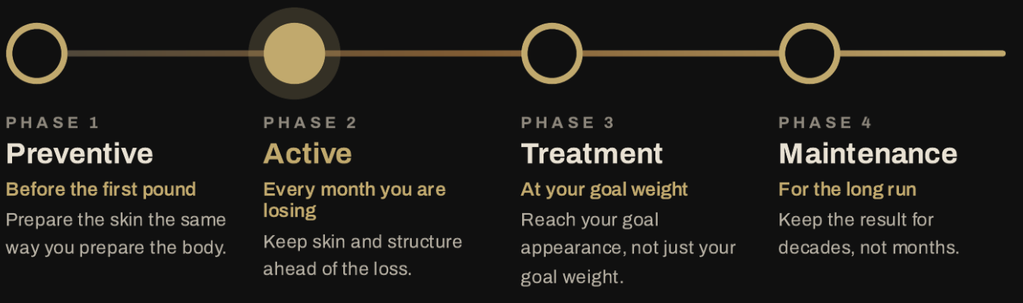
Phase 1: Preventive (before the first pound, or the day you start)
Take the same approach to your skin that you take to your weight loss. Small, steady movement in the right direction.
- Skincare routine: Alastin Reform and Repair · Pavise skin care (DAD)
- Collagen stimulation: Sofwave · AVAVA
- Early biostimulation: Sculptra · Radiesse, to build collagen before the loss starts to show
- The basics: gradual, sustainable loss where possible · protein · hydration · daily sunscreen
The skin you build now is the skin you treat later.
Phase 2: Active (every month you are still losing)
This is the phase most people skip, and it is the one that matters most. The weight is coming off and collagen is falling behind. It is also where patients and providers tend to be the most passive, which is exactly backward. As long as you are still losing, you are still in this phase.
- Stacked skin: Sofwave · AVAVA · Skinny Sculptra (a diluted Sculptra for skin quality rather than volume) · Radiesse · other biostimulation
- Regenerative skin: Renuva, a regenerative matrix that supports your own tissue as it rebuilds
- Regenerative volume: dermaClae · Lipoderma · AlloClae for the body
- Skincare continues: Alastin Reform and Repair · Pavise (DAD)
If you are on a GLP-1 right now, this is the phase to pay attention to.
Phase 3: Treatment (at your goal weight)
Once you hit your goal weight, the goal becomes your goal appearance. I want you to look as good as you feel. This is where the full range of options opens up, and many of them work better because of what was done in the Active phase.
- Non-invasive (no downtime): AVAVA · Sofwave · RF microneedling (Morpheus8, Vivace) · Sculptra · Radiesse · dermaClae · Lipoderma · AlloClae for the body
- Minimally invasive (days, not weeks): targeted filler (Juvéderm Voluma, RHA 4, Restylane Lyft) · MyEllevate · Renuvion · Quantum · thread lifts
- Surgical (the most change): face and neck lift · midface lift · brow lift · blepharoplasty · lip lift · fat transfer
Phase 4: Maintenance (for the long run)
GLP-1s have changed how we think about facial aging. We now see young patients with mature skin concerns. The goal is not to hold a result for six or twelve months. It is to keep it for the next several decades.
- Skin health: a good skincare routine
- Stacked skin: Sofwave · AVAVA · Sculptra · Radiesse
- Regenerative volume: dermaClae · Lipoderma · AlloClae for the body
- Tightening: Sofwave · other energy-based devices (EBD)
- Your weight: a stable weight is what keeps any of these results in place
Should I just put the volume back?
Usually not. Many patients worked hard to lose facial fullness. Refilling the old face undoes the thing they wanted. The goal is a structured, healthy, sculpted face that fits your new body, not the face you had before.
Volume is not the enemy. Random volume is. When I add volume, it has three jobs:
- Targeted. Only where support was actually lost, in the right layer.
- Structured. Placed to lift and define the cheekbone, chin, jawline and temple.
- Strategic. Paired with skin and collagen work so the envelope fits the frame.
Structural volume works best near the anchor points of the face, where it lifts and defines. Filling the soft spaces between them is what makes a face look heavy. That is the whole difference between a face that looks rested and one that looks done.
What is skin stacking?
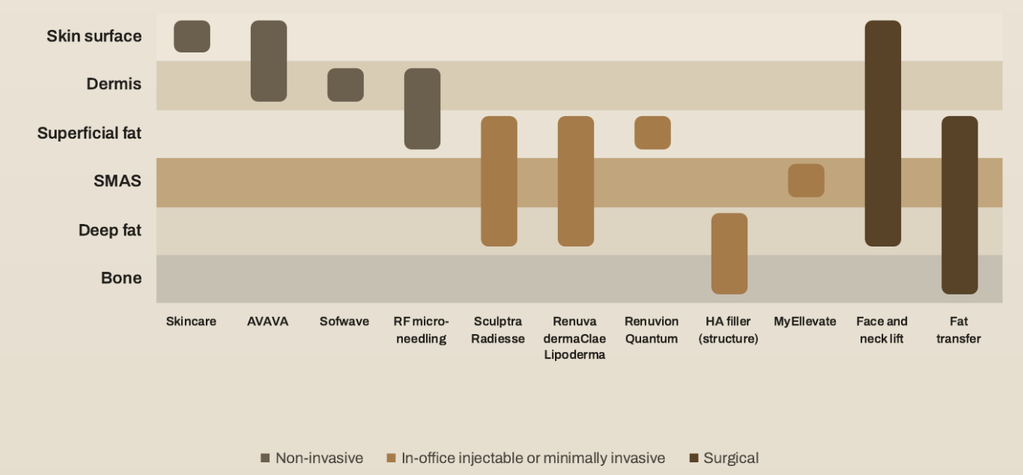
Skin stacking means treating the face layer by layer, from the surface down, so each treatment supports the next. One treatment is a treatment. Stacked, it is a plan.
| Layer | Treatments | What it does |
|---|---|---|
| Skin surface | Alastin · Pavise · AVAVA | Quality, texture and repair |
| Collagen | Sofwave · RF microneedling · other energy-based devices | Stimulates collagen to firm the skin |
| Biostimulation | Sculptra · Radiesse | Builds collagen and gradual support |
| Regenerative | Renuva · dermaClae · Lipoderma · AlloClae (body) | Natural support from processed adipose tissue |
| Strategic structure | Juvéderm Voluma · RHA 4 · Restylane Lyft · MyEllevate · Renuvion · facelift · fat transfer | Definition and lift, not puff |
What are dermaClae, Lipoderma and Renuva?
They are regenerative, off-the-shelf options made from processed donor adipose tissue. They give natural volume without liposuction or a donor site, which matters after major weight loss, when there is often very little of your own fat left to harvest.
For years, restoring facial volume meant one of two things: traditional filler, or harvesting your own fat. After a big weight loss, there often isn’t much fat left to take. This newer category changes that.
- dermaClae: a sterilized adipose injectable for structural facial volume. Final results show in about 4 to 6 weeks and typically last much longer than HA filler. Think fat-transfer-style results without the harvest.
- Lipoderma: finer, built for the face and delicate areas where subtle, natural volume matters.
- Renuva: a regenerative matrix that supports your own tissue as it rebuilds, so the change comes in gradually over a few months.
- AlloClae: the same thinking, scaled up for the body, for patients treating the body alongside the face.
Because they are regenerative rather than simply space-filling, these work in the Active phase while you are still losing, in the Treatment phase alongside structure, and in Maintenance to keep the result.
Do I need a facelift for Ozempic face?
Most patients do not. A face and neck lift earns its place when there is truly too much loose skin to tighten. If you can gather loose skin at your jawline or neck in your hand, no amount of filler or energy will fix it.
We are seeing more young patients choose surgery now, and I understand why. They want results that look natural, not overfilled, and that last. A modern preservation deep plane facelift repositions the deeper tissue rather than just pulling skin, and the result often lasts 10 to 15 years. Fat transfer is still a great option when there is enough of your own fat to work with.
How much downtime does each treatment have?
Before a consultation, the most useful thing to know is what each route costs you in time. These are general patterns in our practice. Your own plan is set at consultation.
| Treatment | Where | Sessions | Downtime | When you see it |
|---|---|---|---|---|
| Skincare (Alastin, Pavise) | At home | Daily | None | Builds over weeks |
| Sofwave | In office, no numbing | Usually one, repeated as needed | None | Over a few months; up to 18 months |
| AVAVA | In office, topical numbing | Series of 2 to 3 | Minimal | After the first session; lasts 1 to 2 years |
| RF microneedling | In office, topical numbing | Series of 3 to 4 | A few days of redness | Texture first; lasts 1 to 2 years |
| Sculptra · Radiesse | In office, local | A series | Minimal bruising and swelling | Gradual; often up to 2 years |
| HA filler | In office | One visit, sometimes staged | Minimal bruising and swelling | 10 to 14 days; 6 to 18 months |
| dermaClae · Lipoderma | In office, local | One visit or staged | Brief swelling | About 4 to 6 weeks; longer than HA |
| Renuva | In office, local | One visit or a short series | Brief swelling | Gradual, over about 3 months |
| Renuvion · Quantum | Access points, local or sedation | Usually one | Days, not weeks | Progressive over 3 to 6 months |
| MyEllevate | In office, local | One | A few days of swelling | After swelling settles; 5+ years |
| Facelift · neck lift | Operating room | One operation | One to two weeks | Develops over months; 10 to 15 years |
| Blepharoplasty · lip lift | Operating room or office | One | About a week | Weeks to a couple of months |
| Fat transfer | Operating room | One operation | One to two weeks of swelling | 3 to 6 months as the fat settles |
Most patients need a series rather than a single visit, especially when combining volume with skin tightening. Mild bruising, swelling and tenderness are expected after most of these and settle quickly. Every treatment has risks as well as benefits, and those get discussed properly in person, not on a web page.
The whole plan on one page
Find the row you are in. Then read across it.
| Phase | Skin health | Volume | Skin laxity |
|---|---|---|---|
| Preventive | Alastin · Pavise · Sofwave · Sculptra · Radiesse | Protect it: gradual loss, protein, hydration | Sofwave · AVAVA |
| Active | Skincare · AVAVA · Renuva · Sculptra · Radiesse | Skinny Sculptra · dermaClae · Lipoderma · AlloClae (body) | Sofwave · stacked skin |
| Treatment | Sofwave · AVAVA · RF microneedling · biostimulators | Juvéderm Voluma · RHA 4 · Restylane Lyft · Sculptra · Radiesse · dermaClae · Lipoderma · AlloClae (body) · fat transfer | Sofwave · Renuvion · Quantum · MyEllevate · face and neck lift |
| Maintenance | Skincare · Sofwave · AVAVA | Sculptra · Radiesse · dermaClae · Lipoderma · AlloClae (body) | Sofwave · energy-based devices (EBD) |
Nobody needs everything. Everyone needs a plan.
How do I prepare for an Ozempic face consultation?
Think through these before you come in and the conversation starts a long way ahead of where it usually does:
- Where am I in my journey? Haven’t started, actively losing, at goal weight or maintaining.
- Does my face read as hollow, loose, dull or a mix?
- Which areas bother me most: temples, under-eyes, cheeks, lips, jawline and jowls, or neck?
- When I lift the skin at my jawline, does the jowl disappear, improve a little or not change?
- How do I feel about added volume: subtle only, open to it if it is structural, or want to avoid it?
- How much downtime can I realistically take: none, a few days, or one to two weeks?
- How much weight have I lost, and how much is left to lose?
- What am I doing for skincare now, and what treatments have I had before?
- What do I want people to notice, and what is my biggest worry?
Frequently asked questions about Ozempic face
Will I get Ozempic face?
Not everyone does. It comes from rapid weight loss, not the medication itself, and how much it shows depends on your age, genetics, how fast and how much you lose, and your facial structure.
Should I wait until I finish losing weight?
For surgery, generally yes. I want you at a stable weight. For skin health, no. Starting early, and by month three at the latest, usually means less treatment later.
Will Ozempic face go away on its own?
No. If you keep the weight off, the changes stay. If the weight comes back, the face may look fuller again, which is not the goal either.
Won’t filler just make me look puffy?
Not when it is used strategically. Structural filler is placed deep to lift and define, and it is paired with skin work. Sculpted, not stuffed, is the whole point.
What is the best treatment for Ozempic face?
There is no single best one. The best plan matches your mix of volume loss, skin health and laxity with the right treatments, in the right phase.
Can I get treatments while I am still on a GLP-1?
Yes. Most skin health and regenerative treatments work well during the Active phase, and that is often the smartest time to start. Surgery is the exception. For a facelift, I want your weight stable first.
How long do results last?
It depends on the treatment, from months for some fillers to 10 to 15 years for a facelift. Keeping your weight stable and your skin healthy is what holds any result in place.
Can my face be treated alongside my body?
Yes. Ozempic face is commonly treated alongside breast, tummy tuck, buttock and body contouring, so the whole result looks cohesive.
Where can I get Ozempic face treatment in Austin?
At Austin Plastic Surgeon, we treat Ozempic face at our offices in Austin, Westlake Hills and San Antonio, with surgery in our Quad A accredited surgery center. Out-of-town patients can use our Fly-In Program, and financing is available.
You did the hard part. Let your face catch up.
Ozempic face is one of the most manageable concerns I see, and there are more options now than ever. Skin stacking, regenerative volume and modern surgical techniques mean the answer is no longer to just fill the face back up. If you have done the work of losing the weight, you deserve to look as good as you feel.
| Office | Address | Phone |
|---|---|---|
| Austin | 10622 Burnet Road, Suite 100 | (512) 334-9917 |
| West Lake Hills | 4613-A Bee Caves Rd, Suite 105 | (512) 334-9917 |
| San Antonio | 325 East Sonterra Blvd, Suite 220 | (210) 750-1851 |
Book a consultation at austinplasticsurgeon.com/contact-us or WhatsApp (512) 359-3276. Instagram and TikTok: @austinplasticsurgeon.
Because Confidence Is the Best Contour™
Johnny Franco, MD, FACS is a board-certified plastic surgeon and the owner of Austin Plastic Surgeon. He holds Clinical Faculty status at UT Dell Medical School, co-authored the chapter on GLP-1 surgical preparation in Body Contouring and Liposuction (2nd ed.), and was named to Newsweek’s America’s Best Plastic Surgeons 2026. He hosts the podcast Plastic Surgery Untold and has been through his own weight loss journey.
References
- Franco J, et al. GLP-1 surgical preparation. In: Rubin JP, et al., eds. Body Contouring and Liposuction. 2nd ed. Chapter 67.
- Daneshgaran G, Shauly O, Gould DJ. “Ozempic Face” in Plastic Surgery: A Systematic Review. Aesthetic Surgery Journal Open Forum. 2025;7. doi:10.1093/asjof/ojaf056
- Rao S, Midura I, Mangual KPS, et al. Skin Impacts and Tradeoffs of GLP-1 Therapy. Dermatology and Therapy. 2026. doi:10.1007/s13555-026-01882-z
- This guide is educational. It is not a diagnosis and not a substitute for an in-person evaluation by a board-certified plastic surgeon. Individual results vary. Timings are general patterns in our practice, not a promise for any individual plan.
About Dr. Johnny Franco
Plastic Surgeon · Austin Plastic Surgeon
- Board certification
- American Board of Plastic Surgery (verify)
- Education and training
- Bachelor of Science in Biochemistry, Beloit College
- Doctorate of Medicine, University of Texas Medical Branch at Galveston
- Residency, Plastic Surgery, Saint Louis University School of Medicine (chief resident 2010-2011)
- Training, Microsurgery (cancer reconstruction), Chan Gung Hospital in Taiwan (2011)
- Fellowship, Breast Reconstruction and Fat Transfer, Gent University Hospital in Belgium
- Memberships
- American Society of Plastic Surgeons
- American Society for Aesthetic Plastic Surgery
- Austin Society of Plastic and Reconstructive Surgeons
- Awards
- Merck Index Award
- Walter S. Haven Prize
- NPI
- 1053503672
- Offices
- Austin · San Antonio · West Lake Hills