A patient guide to skin laxity, volume loss and cellulite after GLP-1 weight loss — and every treatment option from a single office visit to a full surgical reshape.
Contents
- 1 The short answer
- 2 The trade
- 3 Why the shape goes
- 4 What is actually under there
- 5 Two tests you can do today
- 6 The spectrum
- 7 The same question, asked properly
- 8 Problem one · Skin laxity
- 9 Worth being clear about
- 10 Problem two · Volume loss
- 11 The option that did not exist before
- 12 What we know so far
- 13 The question we get most
- 14 When the tissue has to be moved
- 15 Surgical · Volume from your own tissue
- 16 Being straight about it
- 17 Problem three · Cellulite
- 18 The part that gets skipped
- 19 Save this page for your consult
- 20 How it actually gets built
- 21 What it is actually like
- 22 Bring this to your consultation
- 23 FAQ
- 23.1 I have no fat left anywhere. Do I have any options?
- 23.2 Will I need surgery?
- 23.3 Should I wait until I have finished losing weight?
- 23.4 Is a BBL still the gold standard?
- 23.5 I already did Sculptra and it didn’t do much. Did I waste my money?
- 23.6 How long does AlloClae last?
- 23.7 Can cellulite actually be treated, or is that marketing?
- 23.8 How many treatments will I need?
- 23.9 Does the order really matter, or is that just how you schedule it?
- 24 One last thing
- 25 Come see us
The short answer
It isn’t one problem. It’s three.
Losing the weight was the hard part, and you did it. What surprises people is the trade — the scale moved and the shape went with it. The buttock is one of the first places to show it, because it is built largely from fat, and a GLP-1 does not let you choose where the fat comes off.
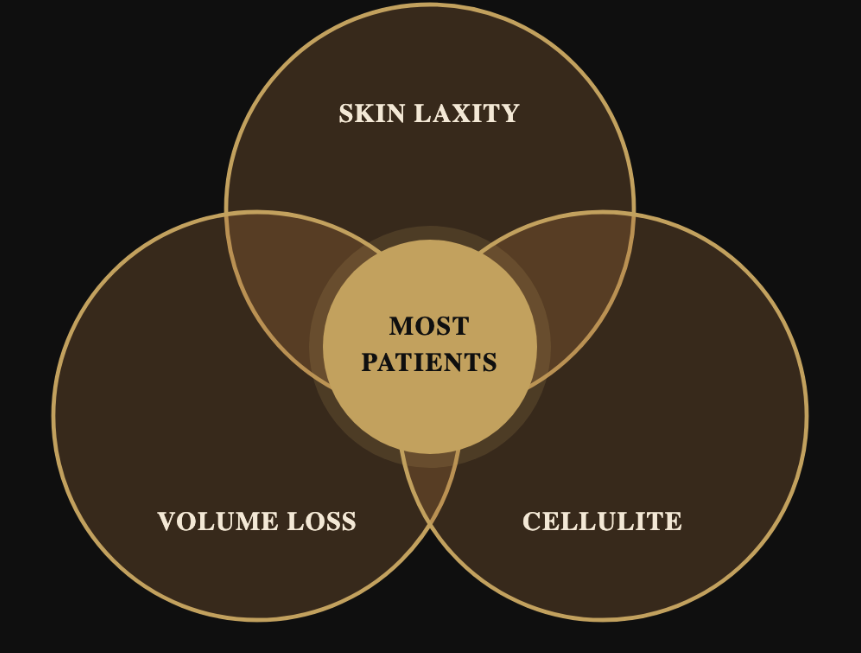
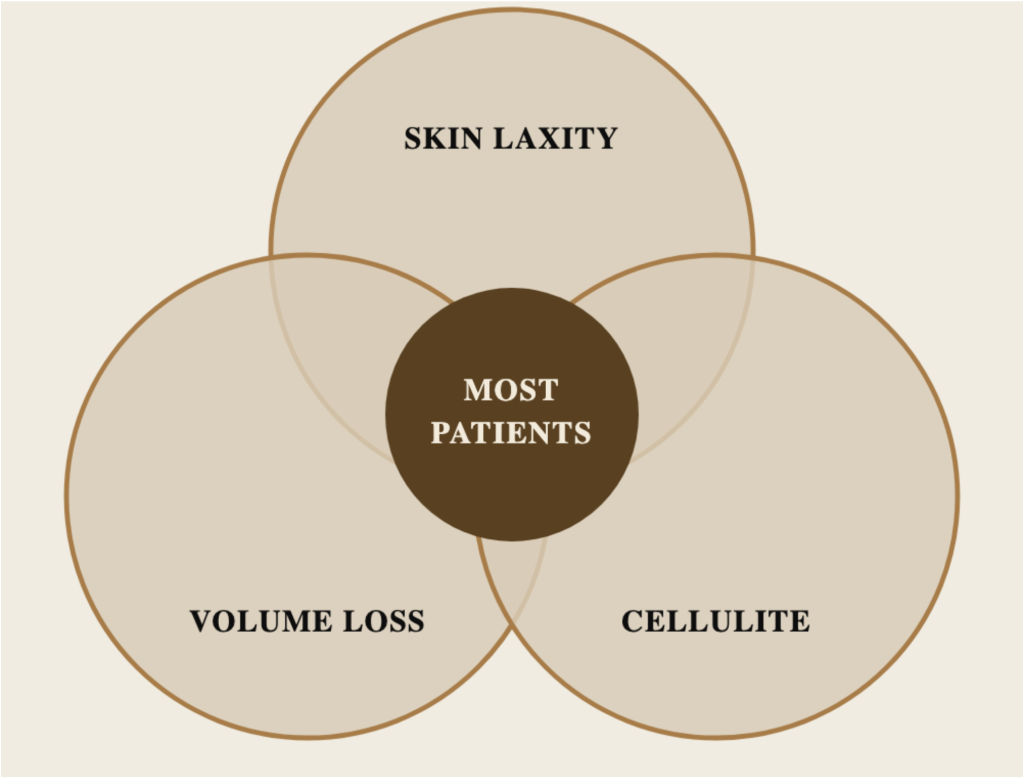
Almost every patient who comes in for this has some mix of three separate things happening at once: the skin envelope has loosened, the volume underneath is gone, and cellulite that was always there is now more visible. They are three different problems with three different fixes. Treat one and you still see the other two in the mirror.
That is why the answer is almost never a single procedure. It is a combination, and the combination depends on how much of each problem you have.
Where most people land
| If this is what you see | What is driving it | And this is the territory |
|---|---|---|
| Flat and dropped up top | Skin · Volume | Tighten the envelope, then rebuild what sat in it |
| Deflated, no projection | Volume | Building, filling, or transferring volume |
| Heavy or dropped at the bottom | Skin · Volume · Cellulite | Laxity first — filling here reads bottom-heavy |
| Dimples that stay when you move | Skin · Cellulite | Releasing the bands underneath |
| A hollow at the side of the hip | Volume | Precision volume, not a lift |
| Two or three of the above | Skin · Volume · Cellulite | A combination across the spectrum |
Almost nothing on that list is a single problem, and there is no fixed order for treating them. Which one gets addressed first depends on which one is doing the most damage to your shape — and that is a judgement made in person, not from a list.
Nothing in this guide asks you to diagnose yourself. You do not need to arrive knowing which operation you want. You need to know the options exist, and that there is a full spectrum between doing nothing and having surgery. Your board certified plastic surgeon will help you decide which combination fits, and in what order.
The trade
You don’t get to pick where it comes off.
GLP-1 medications have been genuinely life changing for our patients. Semaglutide, tirzepatide, Ozempic, Wegovy, Mounjaro, Zepbound — people arrive having lost forty, sixty, ninety pounds, feeling better than they have in years.
The medication does not pick and choose. Fat comes off the belly, the waist and the double chin, which is what you wanted. It also comes off the buttock, the face and the breast, which you did not. The proportions shift, and not in the direction most people were hoping for.
What we hear most often is not a request for a bigger butt. It is the opposite. Patients are fit, they are active, they feel fabulous, and they want the shape to match the work they put in. They want an athletic buttock that fits the body they now have.
You can also get every bit of this without ever taking a weight loss medication. Rapid weight loss of any kind does it. The medications simply made it common enough to need a name.
What you wanted The belly, the waist, the double chin The places you had been trying to change for years.
What went with it The buttock, the face, the breast Volume you were never trying to lose.
What it leaves A shape that doesn’t match A smaller frame with a flatter, lower buttock on it.
The scale moved. The shape went with it.
This is rarely limited to one area. The same patient with Ozempic Butt often has facial volume loss, neck laxity, breast deflation or hand changes happening at the same time, which is why we tend to build one comprehensive plan rather than treating a single area in isolation.
Why the shape goes
Three things are happening at once.
The buttock is a combination of gluteal muscle and a superficial fat layer that does most of the shaping work. When the fat leaves, three separate things change — and they do not change at the same rate in everybody.
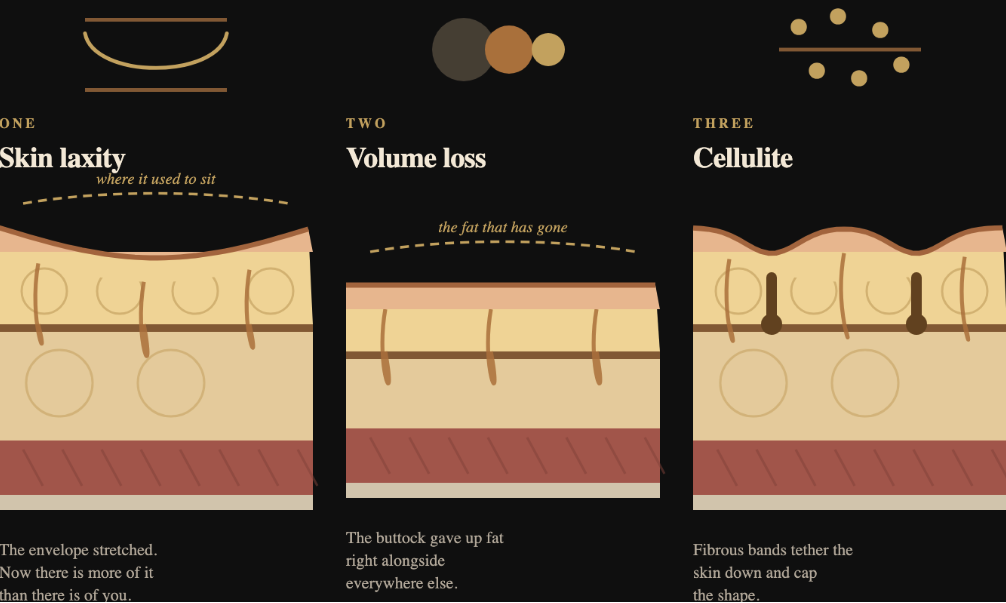
Skin laxity
The envelope stretched, and now there is more of it than there is of you. Rapid loss gives skin no time to recoil. Skin turgor is what it is — some rubber bands snap back, others have been stretched too many times and never do. The more weight lost and the older the skin, the less likely it recovers on its own.
Volume loss
The buttock gave up fat right alongside everywhere else. When the fat goes, the projection goes with it. This is the piece patients notice first in the mirror: it looks deflated rather than smaller.
Cellulite
Fibrous bands tether the skin down to the deeper tissue and cap the shape. GLP-1s do not create these bands. But as you lean out and as the skin loosens, the dimples they cause become far more visible.
Almost nobody has just one of them. That is why the plan is a combination, not a procedure.
What is actually under there
Under the surface. Each layer fails differently.
Every option in this guide works on one of these layers, at one of these depths. Once you can see which layer your problem sits in, the rest of the guide stops being a list of brand names and starts being a map.
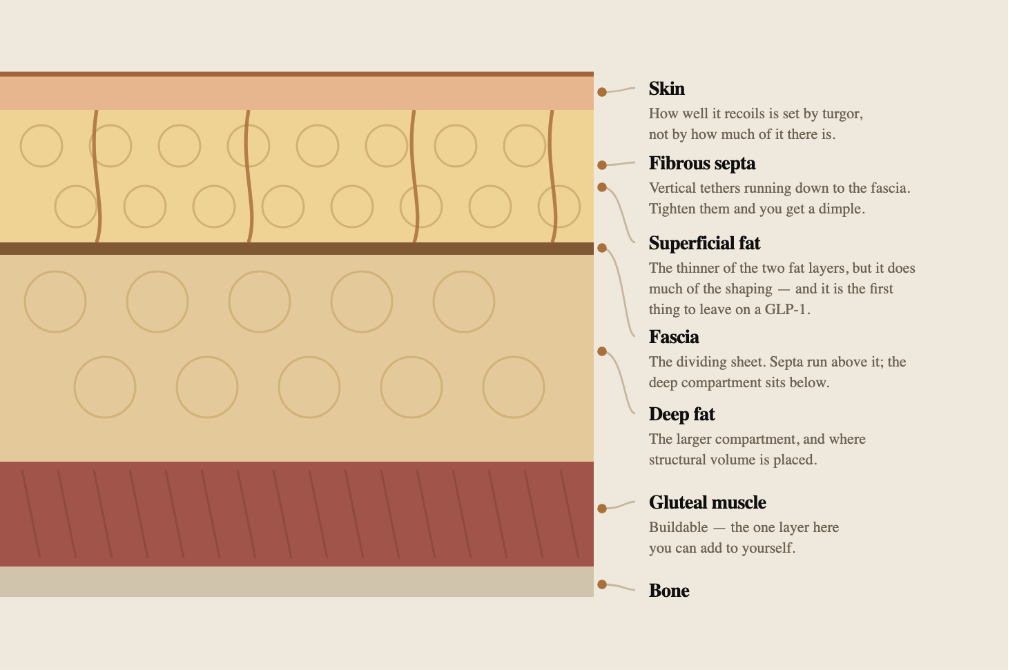
Why this matters more than the brand name
Patients usually arrive asking about a device or a procedure they have seen online. The more useful question is which layer needs the work. A treatment aimed at the dermis will not fix a problem that lives in the fat, however good the treatment is — and that mismatch, rather than a bad treatment, is behind most of the disappointing results we are asked to revise.
Two tests you can do today
Lift the skin. Then look for deflation.
You cannot measure volume loss in a mirror the way you can pinch loose skin on an abdomen. But there are two things you can check, and between them they tell your surgeon most of what they need to know.
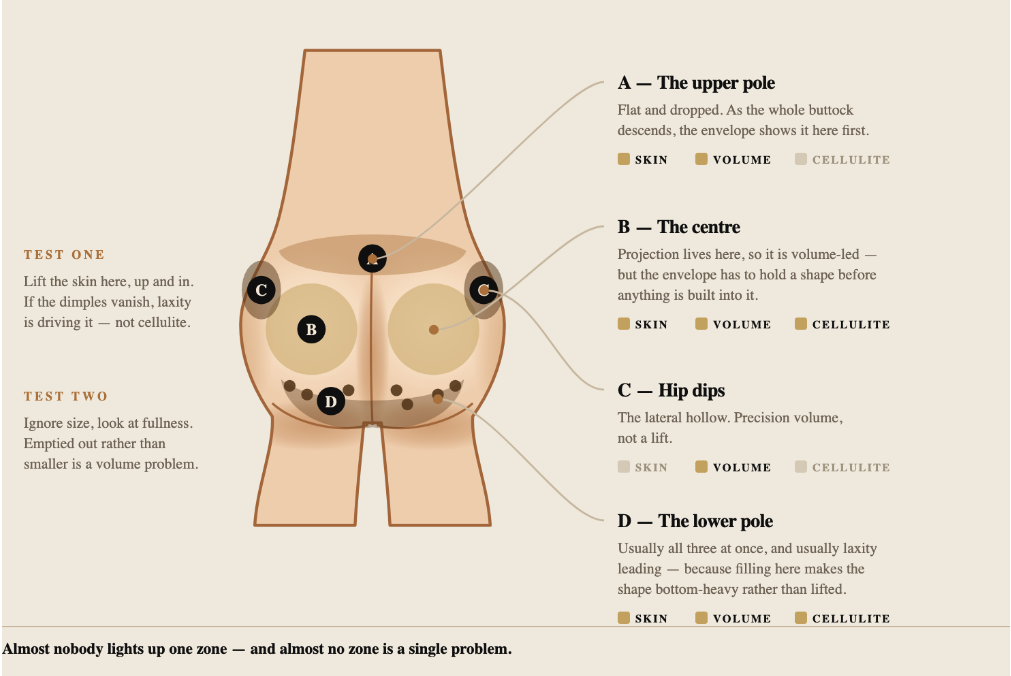
One more question, and it matters most
Do you have any residual fat anywhere? Flanks, abdomen, arms, thighs. This single question decides whether a traditional fat transfer is even on the table. Plenty of GLP-1 patients reach a healthy weight and want to fine-tune their shape, but no longer have enough fat anywhere on the body to harvest. That used to end the conversation. It doesn’t now.
Where it shows is what decides the plan — and most zones are a combination rather than a single problem. The upper pole and the lower pole both involve volume and skin together. The centre is where projection lives, but the envelope has to be able to hold a shape before anything is built into it. The one place we are deliberately careful about adding volume is the very bottom of the buttock, because filling there reads as bottom-heavy rather than lifted.
Shape over size.
The spectrum
There is no line between the options.
Patients tend to arrive thinking there are two choices: do nothing, or have surgery. There is a great deal in between, and the honest answer for most people sits in the middle.
Non-invasive No downtime Energy, muscle and collagen. Same-day return to work. Almost always a series rather than a single visit, and the change builds gradually.
Minimally invasive Days, not weeks Tiny access points, usually under local anaesthetic in the office. Real structural change without an operating room or a general.
Surgical The most change For when the tissue has to be moved rather than coaxed. One to two weeks before returning to most activities.
You can sit at a different point for each problem.
This is the part that surprises people. You might need surgery for your skin and nothing more than an in-office visit for your volume. Or the reverse. The three problems are scored separately, and the plan moves across the columns rather than picking one.
The same question, asked properly
How deep does it actually work?
This one chart explains most of the disagreements patients have read about online. Two treatments are not competitors if they do not reach the same layer — and two treatments that do reach the same layer are genuinely alternatives.
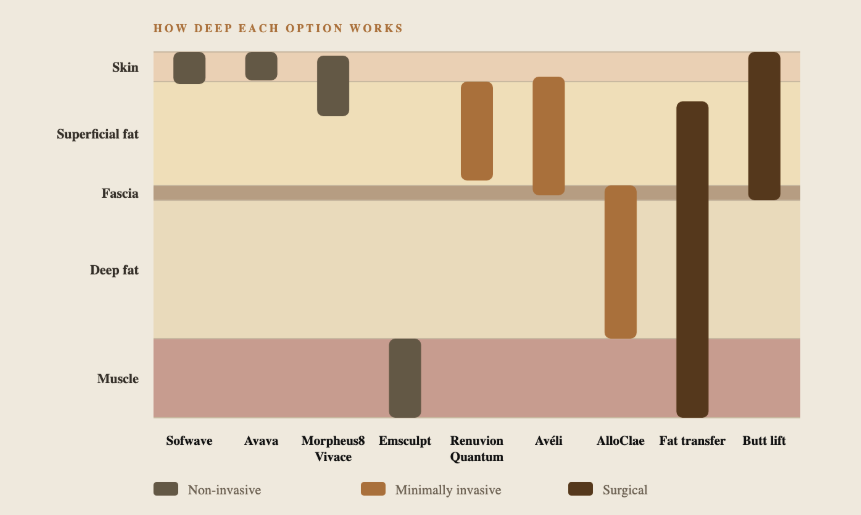
How to read it
Depth is not the same as strength. Sofwave and Avava sit shallow because the dermis is exactly where they are meant to work. A butt lift spans the whole thickness because it removes the layers rather than treating them. What the chart shows is overlap: where two bars sit at the same depth, you have a real choice to make; where they don’t, you may well need both.
Problem one · Skin laxity
Tighten the envelope. Mild to advanced.
Skin is the one that decides whether anything you add underneath will actually hold a shape. You cannot refill a stretched envelope and expect it to look right. Tighten first, then fill.
Non-invasive From the outside Sofwave · Avava · Morpheus8 · Vivace Energy delivered through the skin. Sofwave and Avava for mild laxity; Morpheus8 and Vivace add radiofrequency microneedling, which also improves surface texture and the appearance of cellulite. Best as a finishing layer.
Minimally invasive From underneath Renuvion · Quantum Energy delivered beneath the skin through tiny access points. Renuvion combines radiofrequency with helium plasma, which lets it reach tightening temperature and cool almost instantly. This is the workhorse for moderate laxity.
Surgical Remove the excess Butt lift When there is genuinely too much skin, no amount of energy will be enough. The excess is removed and the remaining tissue repositioned higher and tighter.
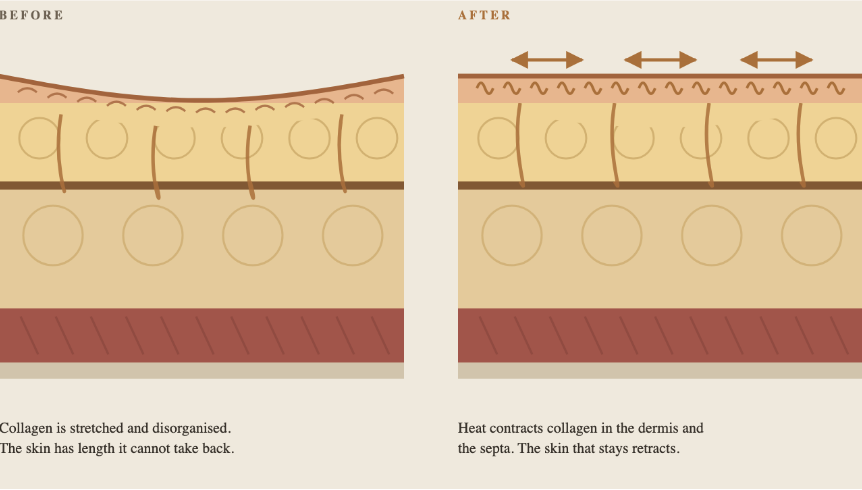
The honest limit
Energy devices work on the character of the skin, not the amount of it. They are excellent for mild and moderate laxity, and they often take a good result and make it look tight rather than merely smaller. What they cannot do is remove skin. If you can gather a significant amount of loose skin in your hand, a device will not get you there, and we will tell you that directly.
Tighten first. Then fill.
Worth being clear about
We can remove skin. We cannot change skin.
Skin turgor — its elasticity — changes once it has been stretched. I explain it as a rubber band that has been over-stretched and no longer recoils. Some snap back. Others have been stretched too many times and never will.
Surgery removes skin. It does not improve the quality of the skin you keep. That is not a limitation of technique; it is what skin is. The more weight lost and the older we are, the less likely the skin is to return to its original turgor.
That is exactly where energy devices earn their place. Renuvion and Quantum RF address the character of the skin, and we use them alongside surgery and liposculpting rather than instead of them. They are increasingly central to large excisional work — not only here, but with thigh lifts, arm lifts and back lifts too.
None of these procedures happens in isolation anyway. A butt lift gets combined with liposculpting, with fat transfer, with auto-augmentation, with energy devices, because almost every patient has more than one thing to solve.
You cannot just fill a deflated balloon. You have to tighten the balloon too.


Real patients. Individual results vary.
Problem two · Volume loss
Put the shape back. With or without your own fat.
After significant weight loss there is often nothing left to harvest. For years that ended the conversation — thin patients were told the results would be unpredictable, or that there was simply no good option. That has changed.
Non-invasive Build and stimulate Emsculpt · Pure Impact · Sculptra · Radiesse Emsculpt builds the gluteal muscle directly, which adds lifted, athletic projection no filler can replicate. Sculptra and hyper-dilute Radiesse stimulate collagen for gradual, subtle volume and better skin quality.
Minimally invasive Off the shelf AlloClae The first filler designed specifically for the body. Real structural volume placed in the office under local anaesthetic, with no donor site required. Most patients are back to normal activity the next day.
Surgical Real volume Fat transfer · auto-augmentation · implants The most volume and the most shape change available, and the only route that also reshapes the waist at the same time. Requires either donor fat or tissue to reposition.
Muscle counts too
Muscle does a great deal of the work in a modern buttock, and it is the one component you can build yourself. Fat lost in the buttock can be partly replaced with muscle. Emsculpt stimulates that directly, and it works best combined with what you are already doing in the gym rather than instead of it.
Which of the three you start with is decided by how much volume you actually need and what you have to build it from. A patient wanting a rounder shape with hip dips filled is a different problem from a patient who has lost the whole projection of the buttock, even though both would describe it the same way in the mirror.
Where Sculptra fits: it is a good product used for the right purpose. It stimulates collagen, it improves skin turgor, and it pairs beautifully with energy devices. What it was never built to do is lift, shape, or create immediate volume in a dense, heavy area like the buttock. For real projection most patients would need far more product than is practical.
The first filler designed for the body.
The option that did not exist before
Meet AlloClae. The first filler built for the body.
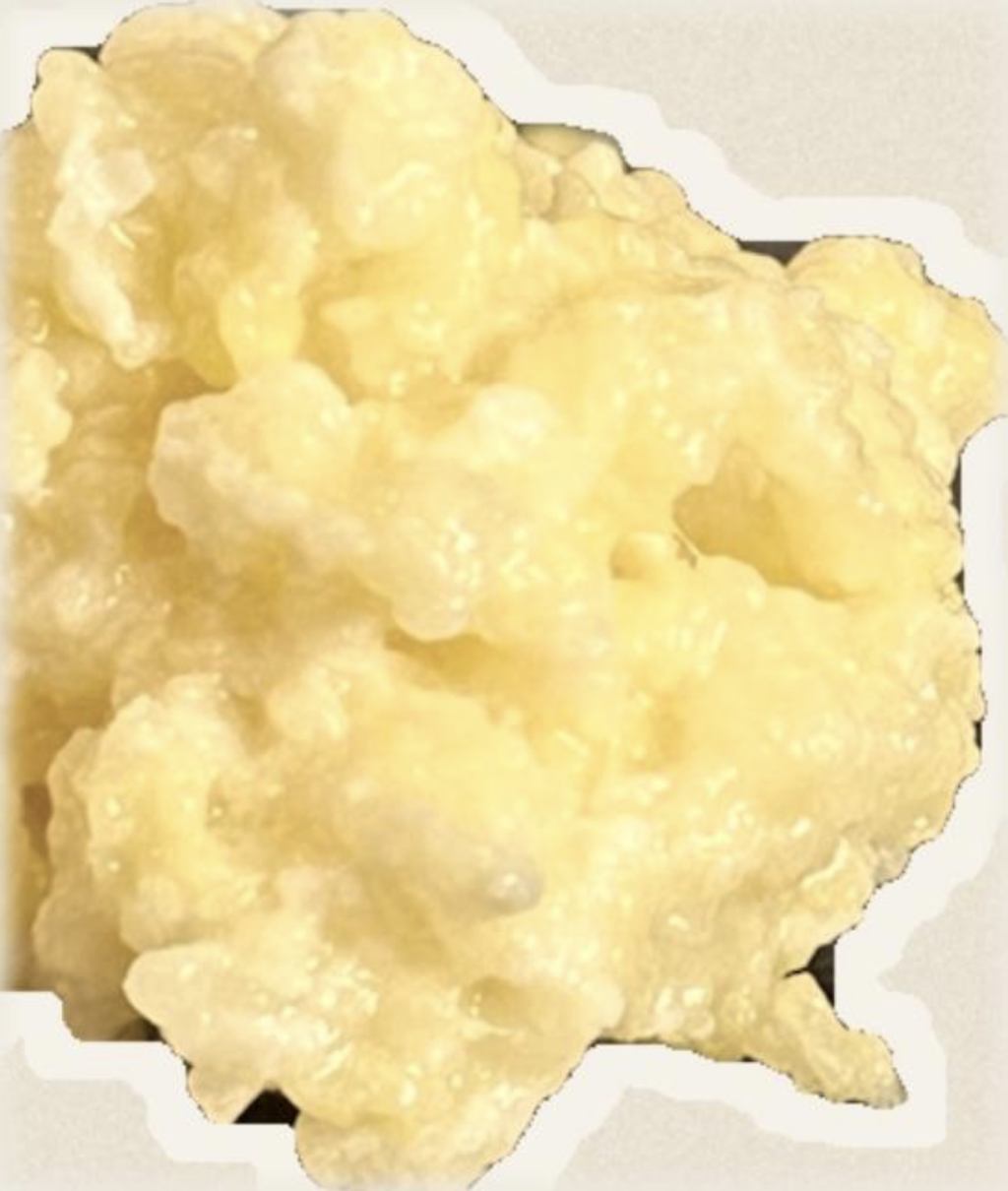
Processed donor adipose tissue, sterilised and prepared into ready-to-use syringes. Roughly 60% adipocyte membrane and 40% extracellular matrix.
AlloClae is an off-the-shelf structural adipose filler designed specifically for the body, not the face. That distinction matters. Facial fillers were never built to lift or shape a dense, heavy area like the buttock. AlloClae was.
The honeycomb structure of the fat is preserved, which is what gives it lifting and shaping power that traditional fillers do not have. It comes in 12.5cc and 25cc volumes — far more than a facial filler — so meaningful change to the buttock, the hips and the surrounding contour is possible in a single visit.
No donor site The product is ready to go. Nothing has to be harvested from a body that has nothing left to give.
In the office Local anaesthetic. No operating room, no general, no drains. Most patients are back at work the next day.
Buildable You can treat, see the result, and add to it over time rather than committing to everything at once.
Where it is strongest Hip dips, contour irregularities, and rounding out asymmetric areas where the buttock has gone flat. It is precision work as much as volume work — and for patients with no residual fat anywhere, it is frequently the only route to volume restoration at all.
What we know so far
It doesn’t sit there. Your body moves in.
What happens underneath the skin is as interesting as what you see on the outside. The product acts as a scaffold, and your own cells migrate in and gradually replace it.
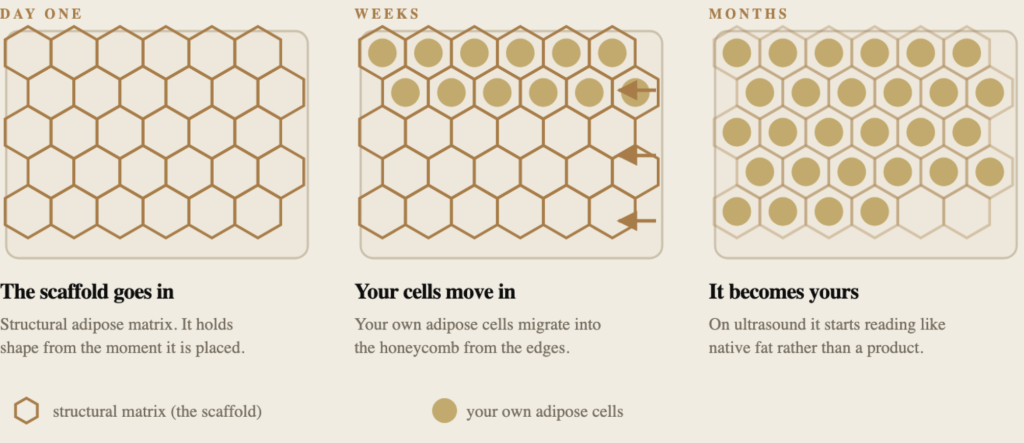
The honest state of the evidence
Our office was part of the longevity study. The first phase showed over 85% retention at six months. In our own practice we have patients more than two years out who have maintained their results. We are also part of an ongoing study using imaging and biopsy to look at what happens to AlloClae under the skin, and so far it appears to do what we believed it would — your body integrates it, which is what gives you a long-term result in the area treated.
When we reviewed serial ultrasounds on our own patients we watched the product slowly integrate. After several months their results were stable, and the ultrasound images looked more like natural fat than like an implanted product. That is the finding that matters most, because it is the difference between something that has to be replaced and something that becomes yours.
If Sculptra or Radiesse disappointed you for your buttocks, you did not waste anything. You can still build shape from here.
The question we get most
AlloClae or a skinny BBL?
Both are good options and they answer slightly different questions. The deciding factor is almost always whether you still have fat somewhere to harvest — and whether you want your waist reshaped at the same time.
| AlloClae | Skinny BBL / fat transfer | |
|---|---|---|
| Donor fat needed | None | Yes — typically 300 to 600cc harvestable |
| Setting | In office, local anaesthetic | Operating room, general anaesthetic |
| Downtime | Back to normal activity next day | One to two weeks of restrictions |
| Reshapes the waist | No | Yes — this is the real advantage |
| Amount of change | Targeted enhancement, buildable in stages | Total body transformation |
| Best for | Lean patients, hip dips, precise correction, no fat to harvest | Patients with residual fat who want a full shape change |
Why a BBL still wins for some patients
A skinny BBL is not just addition. It is subtraction and addition in the same operation — taking the waist down while building the hips and buttock up. That combination is what produces a genuine change in shape, and it is something no injectable can replicate on its own. If you are adding volume only, you have to add a great deal of it to move the needle.
They also combine. We are increasingly seeing pre-expansion, where a smaller amount of AlloClae is used first to prepare and shape an area, and patients who do both rather than choosing between them.
The way I think about modern buttock work is shape over size. AlloClae anchors projection and shape. Energy devices and biostimulants handle the skin. Avéli handles the cellulite. We are not trying to over-volumise anything — we are trying to get the shape right.
When the tissue has to be moved
The butt lift. Rebuilding the structure.
When the skin envelope itself is the problem, neither a device nor a filler is enough. The excess skin has to come out and the remaining tissue has to be repositioned. For the right patient the result is dramatic, because we are not adding volume to a sagging structure — we are rebuilding the structure.
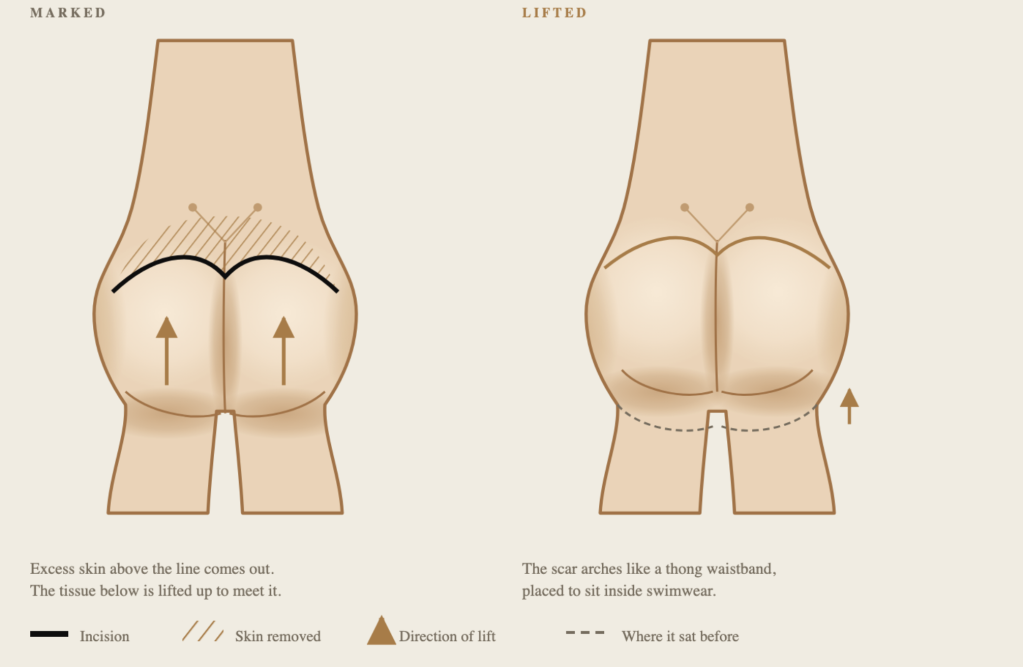
The incision sits at the upper buttock and comes to a point at the midline — the line of a thong or a sweetheart-cut brief, placed so the finished scar hides in swimwear.
The incision Placed for swimwear High on the buttock rather than in the crease. Where it sits is planned with you standing, in the underwear you actually wear.
The recovery One to two weeks Operating room, general anaesthetic, then one to two weeks before most activities. Sitting and sleeping get modified for a while.
The trade A scar, for a shape The honest exchange: a line you can hide, for a change in structure nothing non-surgical matches. If the scar matters more to you than the shape, say so.
It rarely travels alone
A butt lift is usually combined with liposculpting, energy devices for the character of the skin that stays, and auto-augmentation to rebuild projection. The operation on the next page is not an alternative to this one — it is this one, using what it removes.
Surgical · Volume from your own tissue
Auto-augmentation. Rotated, not folded.
Instead of discarding the tissue we are lifting, we use it to build volume back into the buttock. What makes this version different is that the flap does not simply fold over on itself. It is raised laterally and rotated inferiorly about a pivot near the midline — a propeller — and that rotation is what gives it the length to reach the whole buttock.
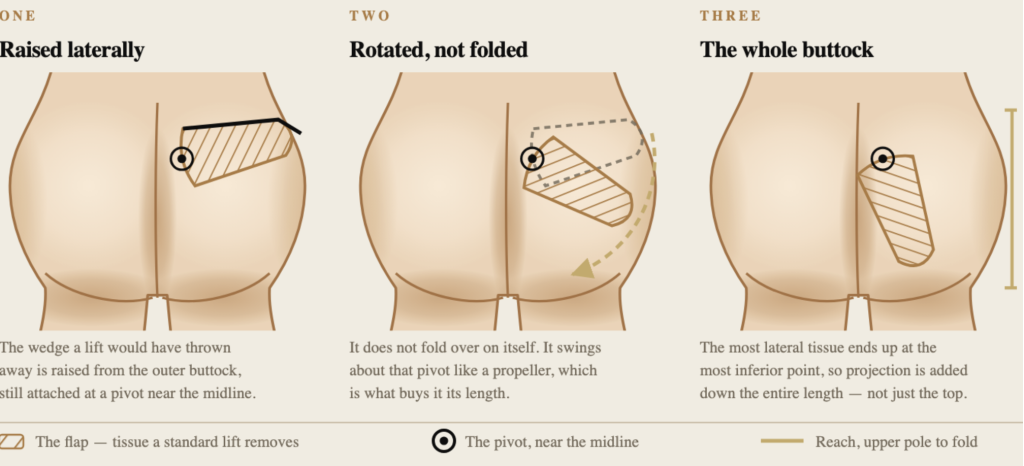
Rear view. The most lateral tissue ends up at the most inferior point.
Why the rotation is the whole point
A traditional auto-augmentation folds tissue under and enhances the upper portion of the buttock. That is useful, but it leaves the lower half untouched. Rotating the flap instead of folding it means the same tissue now runs from the upper pole down to the fold, so projection is added along the entire length. And because it rotates inward rather than staying out on the flank, it does not widen the buttock — it projects it.
No donor site, because nothing is harvested A fat transfer needs fat from somewhere else. This does not — the tissue is already in the field and already being lifted. For a patient with nothing left to harvest, this is the surgical equivalent of what AlloClae does in the office.
It scales up with a circumferential lift When the laxity wraps around to the flanks, back and outer thighs, the same principle applies over a longer incision — with more tissue available to rotate and reuse.
Not a wider buttock — a projected one.
Being straight about it
Who does well with a lift, and who doesn’t.
Good candidate
You have lost a significant amount of weight. The loose skin is real — you can gather it in your hand. The buttock has descended rather than simply deflated. You may have no residual fat anywhere to harvest, which makes auto-augmentation the natural pairing. You are prepared for one to two weeks of genuine downtime, and you understand the trade-off is a scar.
Probably not a candidate
Your laxity is mild to moderate and would respond to energy devices. Your main issue is volume rather than skin. You are not in a position to take one to two weeks of restricted activity. Or the scar is a bigger concern to you than the shape change — which is a completely legitimate position, and one worth saying out loud in consultation.
When the laxity does not stop at the buttock
After very large weight loss, loose skin rarely respects boundaries. If it wraps around to the flanks, the back and the outer thighs, a procedure that addresses only the buttock leaves most of the problem behind. In those cases we often discuss a circumferential approach, which takes one continuous incision all the way around — tightening the waist, lifting the outer thighs and lifting the buttock in the same operation. Auto-augmentation combines with it naturally, using tissue that would otherwise be discarded.
We also do this commonly for patients who had a tummy tuck, then lost more weight. The previous tummy tuck can be converted into a circumferential procedure, which addresses the buttock and outer thighs while freshening up the original result.
A front-only procedure leaves most of the problem behind. Literally.
If you are weighing this up, the useful thing to bring to a consultation is not a decision but a boundary: how much downtime you can genuinely take, and how you feel about a scar you can hide. Those two answers narrow the options faster than anything we can measure.
Problem three · Cellulite
Release the bands. Don’t just fill around them.
This is the problem patients most often assume is untreatable, and the one most often misunderstood. A dimple is not a surface problem. It is a fibrous band running from the skin down to the deeper tissue, pulling the skin down like a tether.
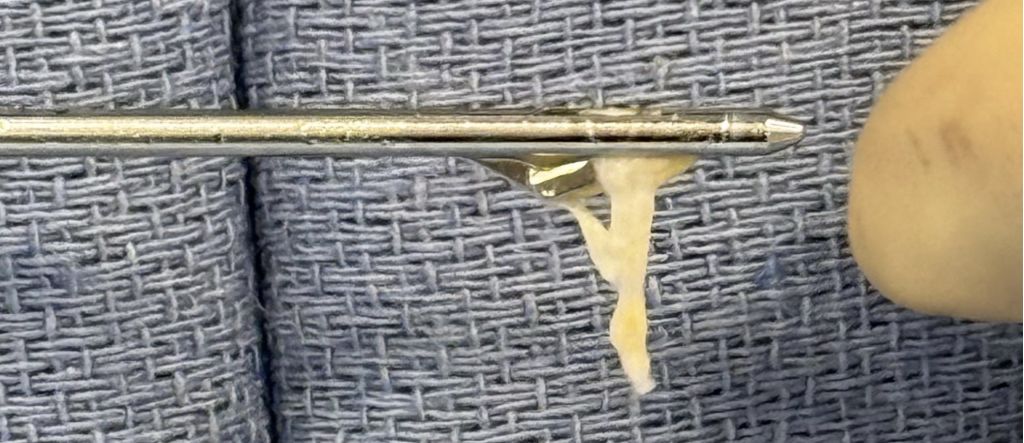
An actual fibrous band, released and lifted out on the tip of the device. This is the structure causing the dimple — which is why treating the surface alone does so little.
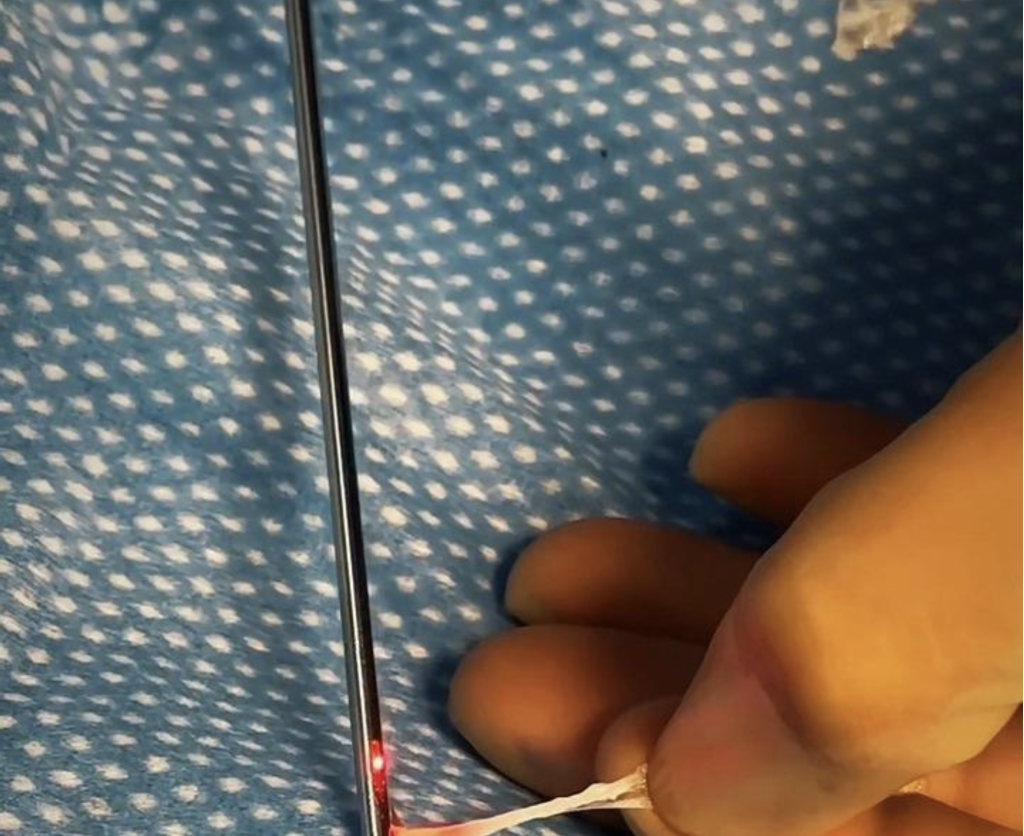
The guiding light shows the tip’s position under the skin.
GLP-1 medications do not create these bands — everyone with dimpling had them beforehand. What changes after weight loss is visibility. As you lean out and the skin envelope loosens, the tethering shows far more. Laxity and cellulite make each other worse, which is why they are so often treated together.
Avéli works from underneath. It locates the individual bands and releases them, which lets the skin sit flat. Because it is targeted rather than blanket treatment, it also refines contour in a way that energy devices cannot.
Cellulite · The spectrum
Three ways it gets handled.
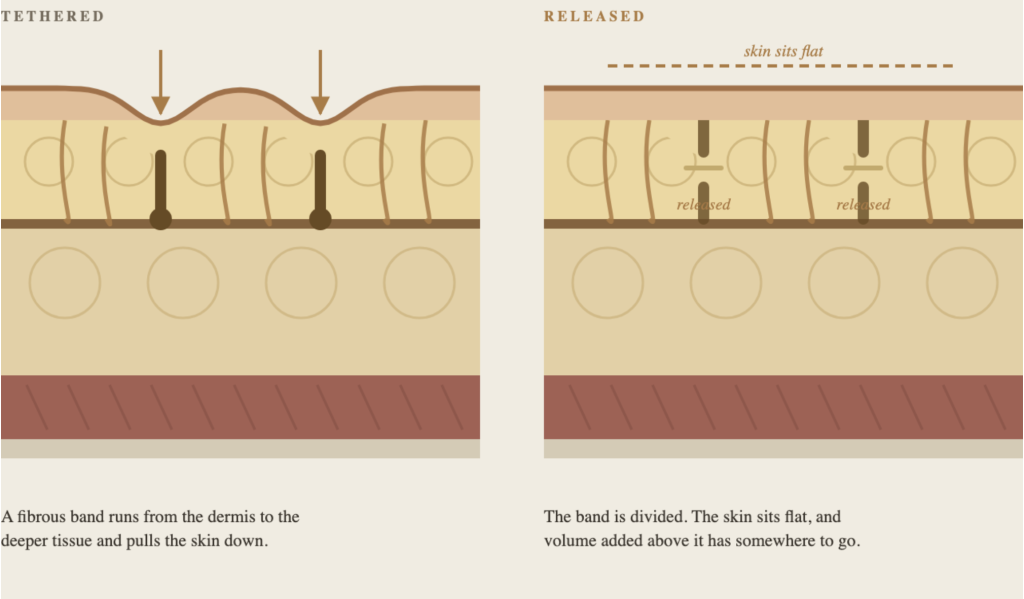
Avéli releases the band from underneath. Once the tether is gone, volume added above it has somewhere to go.
Non-invasive Smooth the surface Energy-based skin treatments and RF microneedling — Morpheus8 and Vivace. These improve the appearance of cellulite by tightening and refining skin texture. They do not release the bands, and they work best as a finishing layer over volume restoration.
Minimally invasive Release the bands Avéli, on its own or refined alongside AlloClae. This treats the actual cause rather than the appearance. For most patients with true dimpling, this is the step that makes the difference.
Surgical Release and lift Avéli combined with a butt lift, or used to maximise the result of a BBL. When skin is being removed and repositioned anyway, releasing the tethers at the same time gets far more out of the operation.
Stay ahead of it. Patients who address laxity and cellulite while they are still losing weight, rather than waiting until the end, frequently get meaningful results from minimally invasive treatment alone and avoid surgery altogether. If you are currently on a GLP-1 and reading this before the problem is fully developed, that is the single most useful thing in this guide.
Volume does not release a band.
The part that gets skipped
The order matters as much as the list.
Two patients can be offered exactly the same three treatments and get very different results, because sequence changes what each one is able to do. What the order is, though, is not fixed. It is decided by which of the three is doing the most damage to your shape.
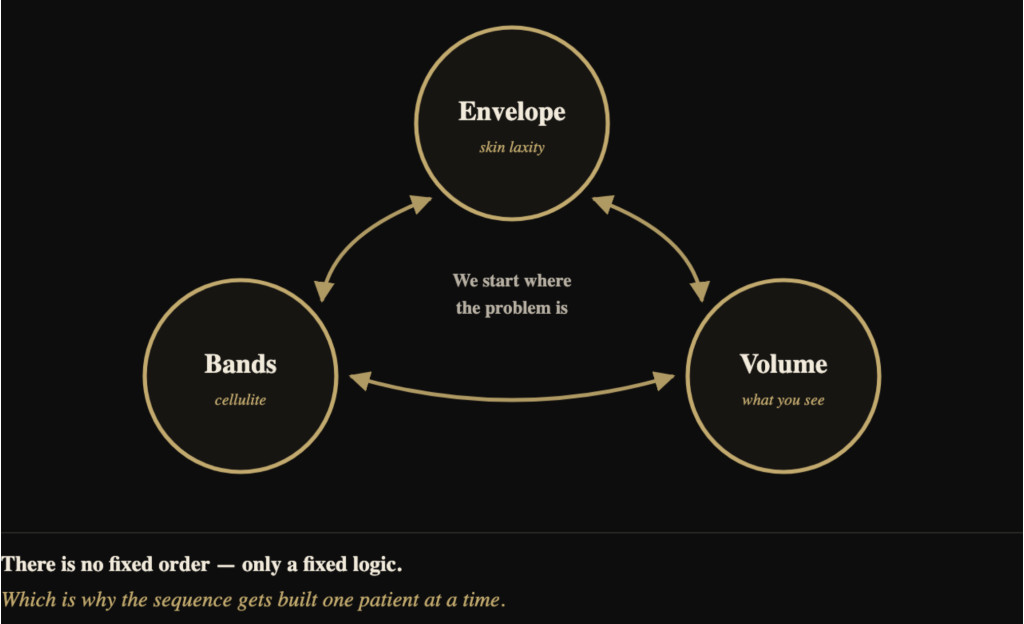
Usually first The envelope An envelope that will not hold a shape cannot be filled into one. Most of the time this is where we start — but only because most of the time it is what is leading.
Sometimes first The bands When tethering is what is capping the result, releasing comes first. Adding volume around a band that is still tethered just makes a fuller buttock with the same dimple in it.
Sometimes the only one The volume An isolated hip dip, or a buttock that has simply deflated with good skin, is a volume problem and nothing else. Nothing needs to be sequenced ahead of it.
Which is exactly why this gets built one patient at a time
There is no protocol that fits everyone here, and a plan copied from someone else’s is the most reliable way to be disappointed. Being scored properly across all three — by a board certified plastic surgeon who does this work regularly — is what decides where your sequence starts and what it is trying to fix first.
Save this page for your consult
The whole map. Find yourself on it.
- Skin laxity
- Volume loss
- Cellulite
Almost nobody sits in one column. Most plans move across.
Find the row you recognise. Then read across it.
How it actually gets built
Nobody gets one thing. Plans move across.
Three patients, all with Ozempic Butt, all with a different plan. These are the patterns we see most often.
One — Good skin, volume gone
Lost 30 to 40 pounds. Skin snapped back well; the buttock simply looks deflated. The only question is how much volume is available to work with — AlloClae if there is no fat to harvest, fat transfer if there is. Emsculpt runs alongside to build the muscle underneath.
Two — Skin laxity leading
Lost 60 pounds or more and the skin did not keep up. Sofwave or Avava for mild laxity, Renuvion or Quantum when moderate, a butt lift when severe. Volume comes second, and only once the envelope will hold a shape.
Three — Cellulite capping the shape
Volume and skin are reasonable, but dimpling caps the result no matter what is added. Avéli on its own, refined with AlloClae, or used to maximise the result of a BBL. Released first, filled second.
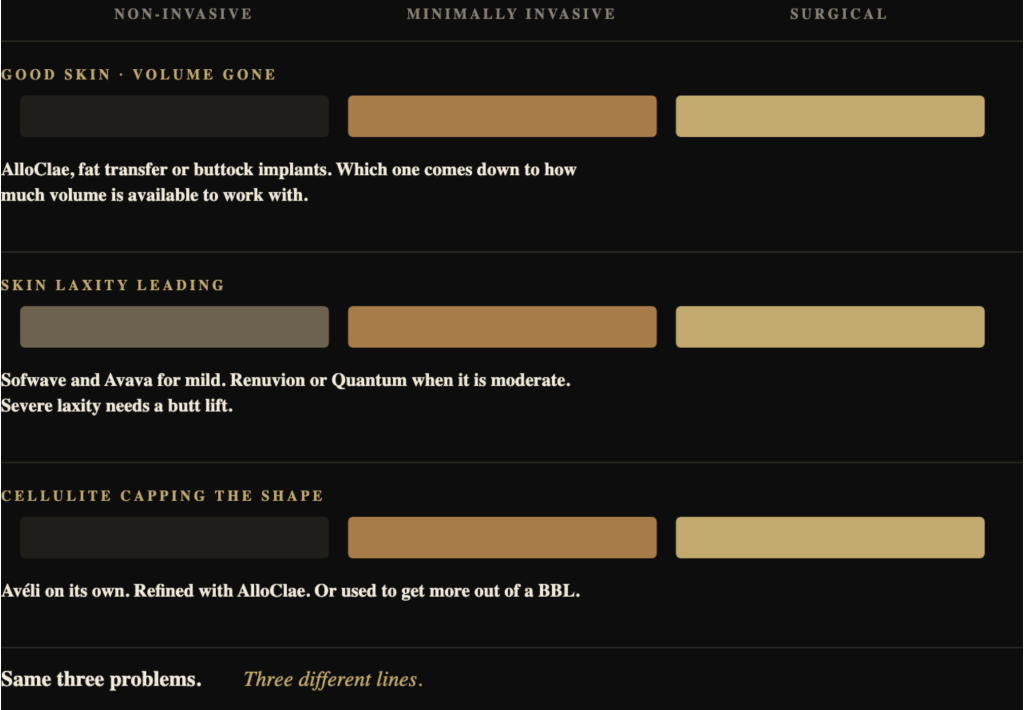
None of them is a single appointment, and none of them sits in a single column. That is the normal shape of a plan here, not a complicated exception to it.
What it is actually like
Downtime, sessions, and when you see it.
The single most useful thing to know before a consultation is what each route costs you in time rather than what it is called. These are the general patterns in our practice; your own plan is set at consultation.
| Route | Where & anaesthetic | One visit or a series | Downtime | When you see the change |
|---|---|---|---|---|
| Sofwave · Avava | In office, topical numbing | A series | None. Same-day return to work | Builds gradually over the weeks after |
| Morpheus8 · Vivace | In office, topical numbing | A series | A few days of redness | Builds gradually; texture first |
| Emsculpt · Pure Impact | In office, no anaesthetic | A series | None | Builds with the treatment course, like training |
| Sculptra · Radiesse | In office, local | A series | Minimal — bruising and swelling | Gradual, over months, as collagen responds |
| AlloClae | In office, local | One visit, or built in stages | Back to normal activity the next day | Shape is there immediately; settles over weeks |
| Avéli | In office, local | Usually one | Bruising and tenderness for days | As bruising and swelling settle |
| Renuvion · Quantum | Access points, local or sedation | Usually one | Days, not weeks | Progressive tightening over months |
| Fat transfer / BBL | Operating room, general | One operation | One to two weeks of restrictions | Months, as swelling settles and the graft takes |
| Butt lift · auto-aug | Operating room, general | One operation | One to two weeks of restrictions | Shape immediately; scar matures over a year |
What to expect either way
Most patients need a series of treatments rather than a single visit, particularly when we are combining volume restoration with skin tightening. Mild bruising, swelling and tenderness are expected after most of these treatments and resolve quickly. Every one of them carries risks as well as benefits, and those get discussed properly in person rather than in a guide.
Bring this to your consultation
You do not need to know the answer. You need to know the questions.
Fill this in beforehand and the conversation starts a long way ahead of where it usually does.
When I lift the skin of my upper buttock, the dimples and the shape:
- Improve noticeably
- Improve slightly
- Don’t change
Looking in the mirror, my buttock reads as:
- Deflated
- Dropped or sagging
- Both
- Neither — mainly dimpling
I can gather loose skin in my hand at:
- The buttock
- The flanks or back
- The outer thighs
- None of these
I still have fat I would happily have removed from:
- Abdomen
- Flanks
- Arms
- Thighs
- Nowhere
Downtime I could realistically take:
- None
- A few days
- One to two weeks
- Weight lost so far, and still to lose
- Previous treatments to the area (Sculptra, Radiesse, energy devices, surgery)
- What I want to look like in clothes
- What I want to look like out of clothes
- My biggest worry about treatment
- Questions I do not want to forget to ask
FAQ
The questions that come up in every consultation.
I have no fat left anywhere. Do I have any options?
Yes, and this is the change of the last couple of years. AlloClae requires no donor site, so a lack of harvestable fat no longer rules out volume restoration. Auto-augmentation is the surgical equivalent — building volume from tissue that a lift would otherwise discard.
Will I need surgery?
Most patients don’t. The majority of plans sit in the non-invasive and minimally invasive columns. Surgery becomes the answer when there is genuinely too much skin to tighten — when you can gather it in your hand.
Should I wait until I have finished losing weight?
For surgery, generally yes — we want you at a stable weight. For skin tightening and cellulite, no. Staying ahead of laxity while you are still losing frequently means minimally invasive treatment is enough, and surgery never becomes necessary.
Is a BBL still the gold standard?
For patients who have fat to harvest and want a genuine change in shape, yes. Nothing else subtracts from the waist and adds to the buttock in one operation, and that combination is what produces the biggest change. It simply requires donor fat that a lot of GLP-1 patients no longer have.
I already did Sculptra and it didn’t do much. Did I waste my money?
No. Sculptra does real work on skin quality and collagen, and it pairs well with energy devices. It was never built to lift or shape a dense area like the buttock. You can build on top of what you have already done.
How long does AlloClae last?
The first phase of the longevity study showed over 85% retention at six months. In our practice we have patients more than two years out maintaining their results, and an ongoing study is using imaging and biopsy to follow what happens under the skin. So far it appears to integrate as we expected.
Can cellulite actually be treated, or is that marketing?
The bands causing the dimples are real structures and they can be released. That is what Avéli does. Energy devices improve the appearance of cellulite; releasing the band addresses the cause. The two are not interchangeable.
How many treatments will I need?
It depends how much of each of the three problems you have. Non-invasive work is almost always a series. AlloClae can be one visit or built over several. Surgery is a single operation with real recovery.
Does the order really matter, or is that just how you schedule it?
It matters, but not as a fixed running order. Volume added around a band that is still tethered gives you a fuller buttock with the same dimple in it, so tethering gets handled first or at the same sitting. Which of the three leads is decided by whichever is doing the most damage to your shape.
One last thing
You did the hard part. Don’t settle for the mirror.
Ozempic Butt is one of the more fixable concerns we see, and there are more options now than there were even a year ago. AlloClae filled a gap that used to leave a lot of weight loss patients without a good answer. Avéli did the same for cellulite. Energy devices did it for skin.
Every one of the treatments in this guide is excellent in the right patient and disappointing in the wrong one. If you have done the work of losing the weight, you deserve a result you actually like looking at.
Come see us
Austin 10622 Burnet Road, Suite 100 (512) 334-9917
West Lake Hills 4613-A Bee Caves Rd, Suite 105 (512) 334-9917
San Antonio 325 East Sonterra Blvd, Suite 220 (210) 750-1851
austinplasticsurgeon.com · Book a consultation
WhatsApp (512) 359-3276
- Instagram @austinplasticsurgeon
- TikTok @austinplasticsurgeon
- YouTube Austin Plastic Surgeon
This guide is educational. It is not a diagnosis, and it is not a substitute for an in-person evaluation by a board certified plastic surgeon. Diagrams are schematic and are drawn to show treatment principle, depth and placement — individual anatomy, technique and results vary considerably. Photographs are of real patients; individual results vary. AlloClae longevity data reflects the first phase of an ongoing study and our own practice experience. Timings on the downtime page are general patterns in our practice, not a promise for any individual plan.
This guide is educational. It is not a diagnosis, and it is not a substitute for an in-person evaluation by a board certified plastic surgeon. Diagrams are schematic and are drawn to show treatment principle, depth and placement — individual anatomy, technique and results vary considerably. Photographs are of real patients; individual results vary. AlloClae longevity data reflects the first phase of an ongoing study and our own practice experience.